
When you’re working with steel, whether it’s for a massive construction project or a specialized manufacturing application, you’ll inevitably encounter two fundamental terms: steel tubes and steel pipes. While they might seem interchangeable at first glance, these two products have distinct characteristics that dictate their ideal applications, performance, and even cost. Ignoring these differences can lead to costly mistakes, project delays, and even safety hazards. So, how do you tell them apart, and why does it matter?

Our team of engineers ensures every project, from design to execution, adheres to the highest standards of responsible steel usage.
Think of it this way: a pipe is primarily designed to transport fluids or gases, while a tube is often used for structural support or mechanical applications. This core distinction influences everything from their manufacturing process to their precise dimensional specifications. Let’s dive deeper into what makes each unique.
The Core Differences: Pipe vs. Tube
The most significant differences between steel pipes and steel tubes lie in their shape, measurement, and manufacturing tolerances. These factors directly impact how they perform under stress and in various environments.
Shape and Application
- Steel Pipes:
Almost exclusively round. Their primary function is to convey liquids or gases. This means they need to withstand internal pressure effectively.
- Steel Tubes:
Can be round, square, rectangular, or even oval. Their versatility makes them suitable for a broader range of applications, often where structural integrity or aesthetic appeal is crucial.
Dimensional Measurement: A Critical Distinction
This is where things get particularly technical and important for procurement. Understanding how each is measured is key to getting the right product.
Steel Pipe Dimensions: Nominal Pipe Size (NPS) and Schedule
For steel pipes, you’ll typically hear terms like Nominal Pipe Size (NPS) and Schedule (SCH). It’s a system that can be a bit counter-intuitive at first:
- NPS:
This refers to the approximate inside diameter (ID) of the pipe, but it’s not an exact measurement. For example, a 2-inch NPS pipe doesn’t have an exact 2-inch ID. It’s a standardized reference.
- Schedule:
This number (e.g., SCH 40, SCH 80) indicates the wall thickness of the pipe. A higher schedule number means a thicker wall, which translates to greater strength and pressure resistance. The outer diameter (OD) of a given NPS pipe remains relatively constant, while the ID changes with the schedule.
This standardization ensures interchangeability and compatibility across different manufacturers and systems, which is vital for fluid transport networks.
Steel Tube Dimensions: Exact Outer Diameter (OD) and Wall Thickness
Steel tubes, on the other hand, are measured much more precisely:
- Outer Diameter (OD): This is the exact, specified measurement. If you order a 2-inch OD tube, it will be precisely 2 inches on the outside.
- Wall Thickness: This is also specified precisely, often in inches or millimeters. The inner diameter (ID) is then derived from the OD minus twice the wall thickness.
This precision is crucial for applications where tubes need to fit together perfectly, slide into other components, or maintain specific structural dimensions.
Manufacturing Process and Tolerances
The way they’re made also highlights their differences:
- Pipes:
Often manufactured to withstand high internal pressures, they typically have looser dimensional tolerances. They can be seamless or welded.
- Tubes:
Generally produced with tighter dimensional tolerances and a smoother finish, making them ideal for applications requiring precision, such as machinery parts or structural frameworks. They are also available in seamless or welded forms.

Our factory in China utilizes advanced technology to produce a wide range of steel tubes and pipes, adhering to strict quality controls.
Strength and Performance: What Can They Withstand?
The inherent design and manufacturing of steel pipes and tubes mean they excel in different areas of strength and performance.
Pressure Resistance (Pipes)
Because pipes are designed for conveying substances, their strength is primarily measured by their ability to handle internal pressure. The wall thickness (schedule) is the key factor here. Thicker walls mean higher pressure ratings, making them suitable for demanding oil and gas pipelines or water distribution systems.
Structural Integrity (Tubes)
Tubes, especially square and rectangular ones, are engineered for structural applications. Their strength is often related to their ability to resist bending, torsion, and compression. They are commonly used in frameworks, machinery, and automotive components where precise load-bearing capabilities are essential.
Cost Considerations: Making the Right Investment
Cost is always a significant factor in any project. The price difference between steel tubes and pipes can vary based on several elements.
- Material and Manufacturing:
Due to tighter tolerances and often more specialized manufacturing processes, steel tubes can sometimes be more expensive per foot or meter than pipes of comparable material.
- Volume:
Pipes are often produced in larger volumes and standardized sizes, which can lead to economies of scale and lower unit costs for bulk purchases.
- Application-Specific Needs:
The “cheaper” option isn’t always the most cost-effective in the long run. Choosing the wrong product can lead to premature failure, increased maintenance, or the need for costly replacements. Investing in the correct material upfront saves money and ensures project longevity.
Common Uses: Where Do You Find Them?
Understanding their typical applications can further clarify the distinction.
Applications of Steel Pipes
Steel pipes are the workhorses of fluid and gas transport. You’ll find them in:
- Oil and Gas Industry: Transporting crude oil, natural gas, and refined products across vast distances.
- Water and Wastewater Systems: Delivering potable water and managing sewage.
- HVAC Systems: Circulating refrigerants and heating/cooling fluids in large buildings.
- Industrial Processing: Moving chemicals and other materials within factories.
Applications of Steel Tubes
Steel tubes are incredibly versatile and are found in a wide array of structural and mechanical applications:
- Construction: Structural supports, scaffolding, handrails, and architectural elements.
- Automotive Industry: Chassis components, exhaust systems, and roll cages.
- Machinery and Equipment: Frames, hydraulic cylinders, and conveyor systems.
- Furniture: Modern and industrial-style furniture frames.
- Aerospace: Lightweight yet strong structural components.

From round pipes designed for flow to square tubes for structural support, the variety of steel products is vast.
Key Comparison Table: Steel Tube vs. Steel Pipe
To summarize the critical differences, here’s a quick comparison:
| Feature | Steel Pipe | Steel Tube |
| Primary Function | Conveyance of fluids/gases | Structural support, mechanical applications |
| Shape | Almost exclusively round | Round, square, rectangular, oval |
| Measurement | Nominal Pipe Size (NPS) & Schedule (SCH) | Exact Outer Diameter (OD) & Wall Thickness |
| Tolerances | Looser | Tighter, more precise |
| Strength Focus | Internal pressure resistance | Bending, torsion, compression resistance |
| Cost | Often lower per unit for bulk, standardized | Can be higher due to precision and versatility |
| Common Uses | Pipelines, plumbing, HVAC | Frames, machinery, automotive, construction |
Need help sourcing steel from China? Our team helps international buyers compare steel mills, verify certifications, inspect factories, confirm technical specifications, and secure mill-direct pricing before payment. Share your project requirements today for quotation support and supplier evaluation.
WhatsApp Us for Free a Consultation
Choosing the Right Steel Product for Your Project
Making the correct choice between steel tubes and steel pipes boils down to understanding your project’s specific requirements. Ask yourself these questions:
- What is the primary function? Are you transporting something, or building a structure?
- What are the dimensional requirements? Do you need precise external fitment, or is internal flow capacity more critical?
- What kind of stresses will it endure? Internal pressure, or external bending and compression?
- What are the regulatory standards? Many industries have specific standards for pipes (e.g., ASTM A106 for seamless carbon steel pipes for high-temperature service) and tubes.
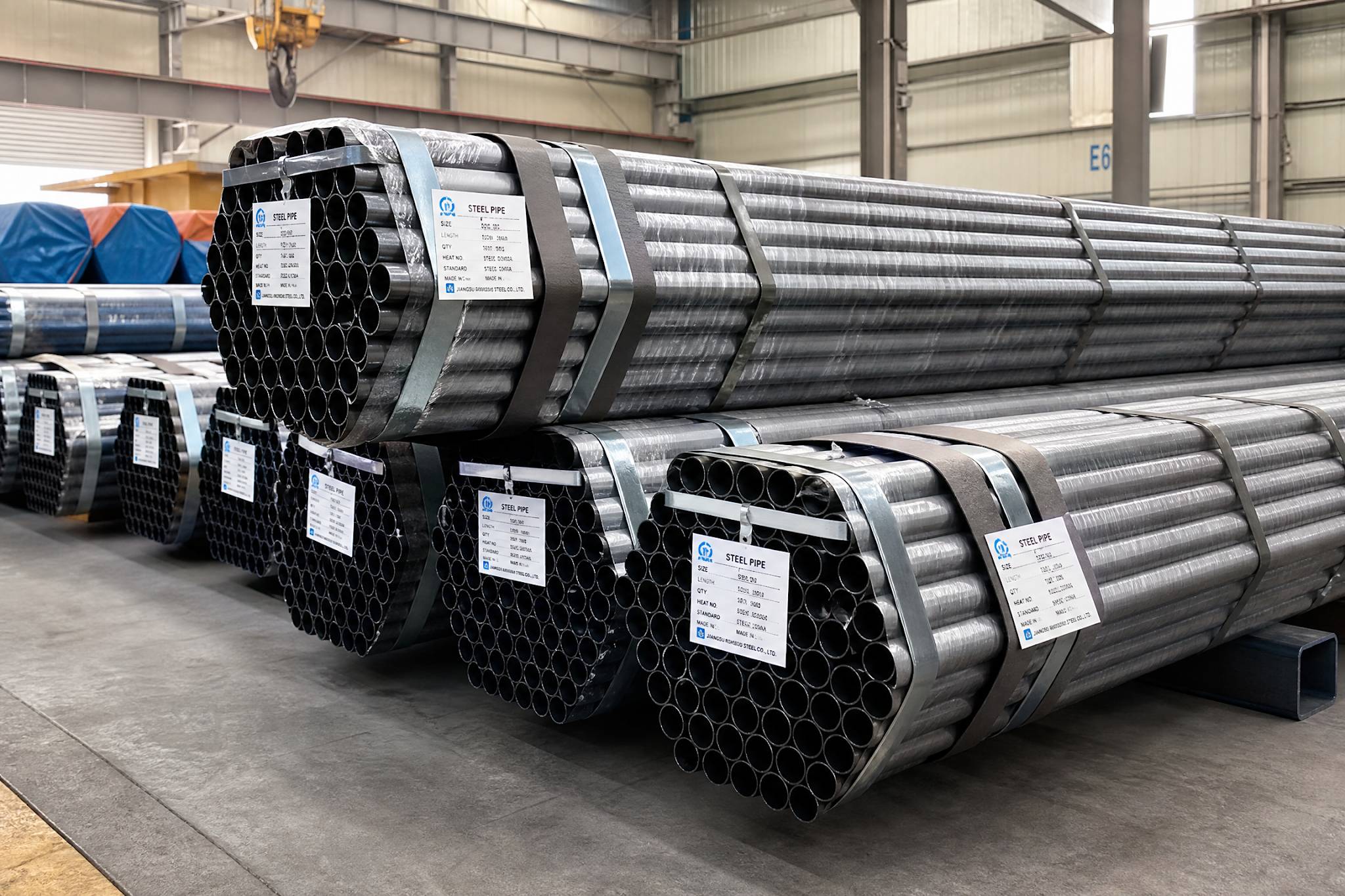
Each bundle of steel pipes and tubes is meticulously packaged and labeled, ensuring safe transit to its destination.
For complex projects, especially those involving international sourcing, partnering with experienced suppliers is invaluable. They can help you navigate the technical specifications and ensure you receive the exact material you need. Our team at Camasteel has a proven track record of success stories in delivering high-quality steel products globally.
The Camasteel Advantage: Your Partner in Steel Procurement
At Camasteel, we understand the nuances of steel procurement. We don’t just supply steel; we provide solutions. Our expertise ensures that whether you need steel tubes for a precision engineering project or steel pipes for a vast pipeline network, you get the right product, on time, and to specification. We pride ourselves on our commitment to quality and customer satisfaction.
We invite you to learn more about us and how we can support your next venture. Our dedicated team is ready to assist you with your specific requirements, offering competitive pricing and reliable logistics.

Our commitment to efficient logistics ensures your steel products are loaded and shipped with utmost care and speed.
Frequently Asked Questions (FAQs)
Q1: Can I use a steel pipe as a structural tube?
While a steel pipe can offer some structural support, it’s generally not recommended as a direct substitute for a structural tube. Pipes are designed for pressure containment, not for precise structural load-bearing where bending and torsional resistance are paramount.
Using a pipe where a tube is specified could lead to structural inefficiencies or failure. Always consult engineering specifications.
Q2: Are steel tubes always seamless?
No, steel tubes can be either seamless or welded. Seamless tubes are made from a solid billet of steel that is drilled and pushed through a die, offering uniform strength. Welded tubes are formed from steel strips and then welded along the seam. Both have their specific applications, with seamless often preferred for higher pressure or critical structural uses, and welded being more cost-effective for many general applications.
Q3: How do I ensure the quality of steel pipes or tubes when importing?
Ensuring quality, especially when importing, is crucial. Key steps include requesting Mill Test Certificates (MTCs) to verify chemical composition and mechanical properties, conducting third-party inspections (like SGS) before shipment, and working with reputable suppliers who adhere to responsible steel practices.
For more insights, you might want to check out our guide on the best steel companies in China.
Conclusion: Precision in Every Project
The distinction between steel tubes and steel pipes is more than just semantics; it’s about fundamental differences in design, measurement, strength, and application. Pipes are optimized for conveying fluids, measured by NPS and schedule, and built to handle internal pressure. Tubes, on the other hand, are designed for structural and mechanical precision, measured by exact OD and wall thickness, and excel in resisting bending and torsion.
Making an informed decision ensures the longevity, safety, and cost-effectiveness of your projects. By understanding these critical differences, you’re better equipped to specify the right material and achieve optimal performance. When you need reliable steel products, remember that precision in selection leads to perfection in execution.
Industrial Buyers: Importing Steel to China?
Are you navigating a serious steel purchase? We understand the complexities involved.
✅ Do you know your steel specifications?
✅ Are you buying in bulk?
✅ Do you need supplier verification in China?
✅ Do you need inspection before shipment?
✅ Do you need support shipping to China?
If you answered yes to these questions, you’re likely handling a significant steel procurement. Share Your Requirements with us today to streamline your import process.